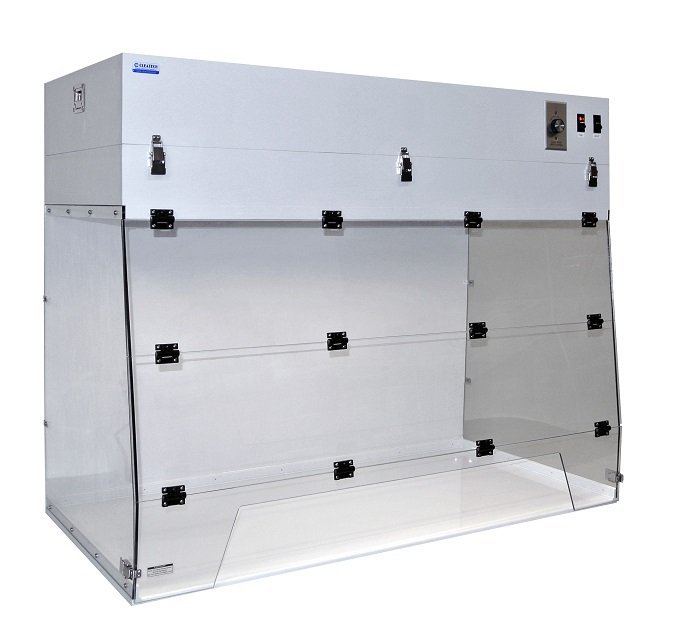
Choosing the right fume hood requires more than comparing dimensions, airflow, or price. You must confirm that the hood’s filtration system can safely handle the chemicals used in your laboratory. Different solvents, acids, bases, and volatile compounds require different filtration capabilities, and an unsuitable filter may allow hazardous vapors to pass through.
Before purchasing a ductless fume hood, evaluate your chemical inventory, exposure risks, filter specifications, and operating conditions. A systematic compatibility assessment helps you select equipment that supports your laboratory’s safety procedures while reducing the risk of unexpected filter breakthrough.
Create a Detailed Chemical Inventory
Start by identifying every chemical you plan to use inside the hood. Do not rely on broad categories such as solvents or cleaning agents because substances within the same category can behave differently during filtration.
Record the following information for each chemical:
- Chemical name and CAS number, where available.
- Concentration and formulation.
- Quantity used during each procedure.
- Frequency and duration of use.
- Expected vapor generation and temperature.
- Potential reaction products or hazardous decomposition products.
Review each substance’s Safety Data Sheet (SDS), particularly the sections covering hazards, handling, exposure controls, and stability or reactivity.
For example, acetone, toluene, and ethanol are organic solvents, but their adsorption characteristics differ. A filter suitable for one application should not automatically be considered suitable for every organic vapor.
This inventory establishes the foundation for evaluating the chemical compatibility of ductless fume hood filters.
Match Each Chemical to the Correct Filter Media
A ductless fume hood captures contaminants and passes air through filters before returning the treated air to the laboratory. Its effectiveness depends on selecting filter media appropriate for the specific chemicals involved.
Activated carbon filters are commonly used to adsorb certain organic vapors. However, not every carbon filter captures every compound effectively. Specialized impregnated carbon or other engineered media may be necessary for particular chemical families.
Consider these factors when assessing filtration compatibility:
Organic solvents: Verify the filter’s stated capacity for each solvent and expected concentration.
Acidic vapors: Confirm that the filter media is specifically designed and validated for the acids involved.
Basic vapors: Check whether the filtration system supports the particular alkaline or amine compounds used.
Mixed chemicals: Obtain evidence that the filter can handle the complete chemical mixture, not just individual substances tested separately.
Reactive chemicals: Evaluate whether adsorption could cause an undesirable reaction or heat generation.
Particle filters, including HEPA filters, are designed primarily for airborne particles and do not independently provide protection against chemical vapors. Do not select a filtration system based on particle filtration alone when vapor control is required.
Review Manufacturer Compatibility Documentation
Product descriptions and general statements such as “suitable for laboratory use” are not sufficient evidence of chemical compatibility. Request documentation that specifically identifies the chemicals supported by the proposed filtration system.
Ask the manufacturer or supplier for:
- A chemical compatibility chart covering your inventory.
- Filter media specifications and intended applications.
- Available test data for relevant chemical vapors.
- Limitations concerning concentration, temperature, and humidity.
- Filter service-life estimates and replacement criteria.
- Procedures for detecting filter saturation or breakthrough.
Look for documented performance under conditions that resemble your actual laboratory processes. If a chemical is absent from the compatibility chart, do not assume that the filter can handle it.
When comparing a ductless fume hood for laboratory chemical vapor control, prioritize documented filtration performance over general product claims.
Assess Chemical Concentration and Usage Conditions
Even a compatible filter can become ineffective if your chemical load exceeds its capacity. Evaluate how much vapor your procedure generates, how often you use the hood, and how long each operation lasts.
Consider the following questions:
- Will you work with small quantities or large volumes?
- Are chemicals heated, sprayed, or left in open containers?
- Could evaporation increase during extended procedures?
- Will several chemicals be used simultaneously?
- Could humidity or temperature affect filter performance?
Higher vapor concentrations and frequent use may shorten filter service life. Chemical mixtures can also behave differently from individual substances, making compatibility assessments more complex.
If your laboratory regularly handles unknown substances, highly hazardous vapors, or processes that produce substantial emissions, a ducted fume hood may be more appropriate. Ask your environmental health and safety (EHS) team to assess the application before selecting equipment.
Establish a Filter Monitoring and Replacement Plan
Chemical compatibility is not a one-time purchasing decision. You must maintain filtration performance throughout the hood’s service life.
Before purchasing, verify that the proposed system provides a documented approach to filter saturation monitoring, breakthrough detection, and replacement. Where applicable, confirm that alarms are appropriate for the chemicals being handled and understand their limitations.
Your operating plan should include:
- A documented filter replacement schedule based on the approved application.
- Monitoring and inspection procedures specified by the manufacturer.
- Clear instructions for responding to alarms or suspected breakthrough.
- Procedures for safely replacing and disposing of contaminated filters.
- Records of chemical use, maintenance, and filter changes.
Never rely on odor alone to determine whether a filter remains effective. Some chemicals have inadequate warning properties, and odor perception varies between individuals. If an alarm activates or breakthrough is suspected, stop the affected operation, follow your laboratory’s emergency procedures, and obtain qualified assistance before resuming work.
Obtain Approval Before Finalizing Your Purchase
Once you have assessed your chemicals, filter requirements, and operating conditions, submit the complete application details to the manufacturer or supplier. Request written confirmation that the proposed hood and filter configuration are suitable for your intended use.
When reviewing ductless fume hood options for controlled laboratory applications, compare chemical compatibility, airflow performance, monitoring features, filter replacement costs, and maintenance requirements.
You can explore laboratory equipment solutions from CleaTech LLC for laboratory and cleanroom applications. Before committing to a model, ensure your EHS team has reviewed and approved the proposed application.
For assistance evaluating your requirements, Contact us today to discuss your laboratory equipment needs.
Frequently Asked Questions
1. How do you verify chemical compatibility in a ductless fume hood?
Prepare a complete chemical inventory, review the relevant SDS documents, and submit the chemical names, concentrations, quantities, and operating conditions to the manufacturer. Obtain documented confirmation that the proposed filter system is suitable.
2. Can one activated carbon filter handle all laboratory chemicals?
No. Activated carbon filters vary in their adsorption capabilities, and some chemicals require specialized filter media. Always verify compatibility for every chemical rather than assuming one filter can handle all laboratory vapors.
3. Why is filter breakthrough a concern?
Filter breakthrough occurs when contaminants pass through the filter instead of being adequately retained. In a ductless hood, those contaminants may return to the laboratory with the recirculated air, creating an exposure risk.
4. How often should ductless fume hood filters be replaced?
Replacement frequency depends on chemical type, vapor concentration, usage patterns, environmental conditions, and filter capacity. Follow the manufacturer’s documented schedule and monitoring procedures rather than relying on a universal replacement interval.
5. When should you choose a ducted fume hood instead?
Consider a ducted system when chemicals are unknown or unsupported by the available filters, when emissions are substantial, or when the hazards cannot be adequately controlled through validated recirculating filtration. Your EHS team should assess the specific application.
Conclusion
Verifying chemical compatibility before choosing a ductless fume hood helps you avoid unsuitable filtration systems and reduce the risk of hazardous vapor exposure. Start with a detailed chemical inventory, confirm filter suitability, evaluate operating conditions, and establish a reliable monitoring and replacement plan.
The most important principle is simple: select a hood based on verified chemical compatibility, not convenience alone. Manufacturer approval and a documented safety assessment should guide your final decision.