

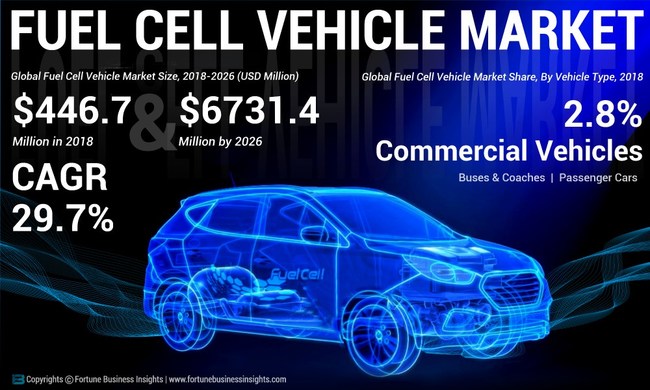
The global fuel cell vehicle market size is set to touch USD 6,731.4 million by 2026, exhibiting a staggering 29.7% CAGR during the forecast period. Increasing air pollution levels caused by cars and other vehicles will propel the growth of this market, according to the new Fortune Business Insights™ report, titled “Fuel Cell Vehicle Market Size, Share and Global Trend By Vehicle Type (Passenger Cars, Commercial Vehicles, Buses & Coaches), By End-User (Private, Commercial), and Geography Forecast till 2026”. The US Environment Protection Agency (EPA) estimates that 75% of carbon monoxide pollution in the US is caused by motor vehicles. Furthermore, according to the Environmental Defense Fund (EDF), on-road cars are responsible for 1/3rd of the smog produced in the US, while vehicles emit 27% of the greenhouse gases (GHGs) in the country. This scenario has created a desperate need to evolve technologies that can curb emissions and help counter the adverse effects of global warming.
Fuel cell vehicles have emerged as a viable solution, owing to their proven efficacy in lowering pollution levels, which is one of the leading fuel cell vehicle market trends. For instance, the US Department of Energy opines that hydrogen-powered vehicles can potentially emerge as zero-GHG emitting machines as they eliminate the need to use fossil fuels such as petroleum and diesel.
The report states that the value of this market stood at USD 446.7 million in 2018 and is expected to soar at a prolific rate in the coming years. The other highlights of the report include:
- Microscopic analysis of the individual market segments;
- An exhaustive study of the market drivers, trends, and constraints;
- Comprehensive research into the regional dynamics of the market; and
- In-depth assessment of the competitive landscape shaping the future of the market.
- Price Hurdles to Inhibit Market Sales
The fuel cell vehicle market growth faces a challenging obstacle in the form of high initial costs of this technology. For example, hydrogen fuels cost roughly $14 per kg, more than double the price of one gallon of gasoline. Moreover, the cost of producing hydrogen is prohibitively high and consumers are preferring regular fossil fuel-powered vehicles as they are more cost-effective, though less energy-efficient. For instance, one can travel the same distance in $2.50 gallon of gasoline as in $5.50 kg of hydrogen fuel. The main reason for the expensive nature of fuel cells is that the technology is still in its nascent stage and is yet to evolve fully. However, despite being pricey, fuel cells in vehicles have a promising future, which augurs well for this market in the long-run.
List of Key Players Covered in the Fuel Cell Vehicle Market Report:
- BMW AG (Munich, Germany)
- Daimler AG (Stuttgart, Baden-Wurttemberg)
- Hyundai Motor Company (Seoul, South Korea)
- AUDI AG (Zwickau, Germany)
- Nissan Motor Corporation (Yokohama, Kanagawa, Japan)
- Toyota Motor Corporation (Toyota, Aichi, Japan)
