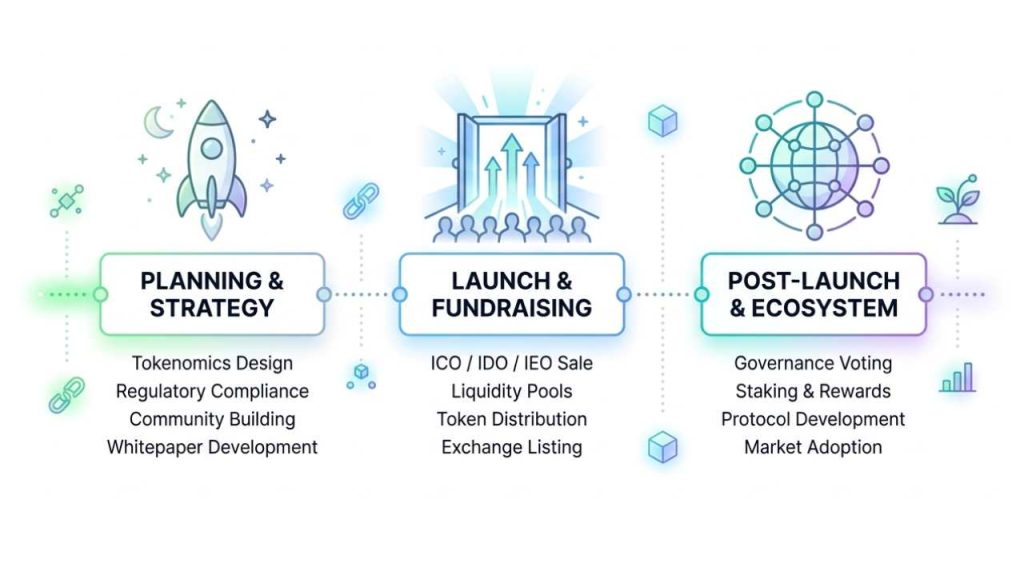
The Web3 ecosystem has transformed how digital businesses raise funds, build communities, and develop decentralized platforms. One of the most important milestones for any blockchain project is a well-structured Token Launch. A successful token launch can help a project attract investors, build a loyal community, and create a sustainable economic model for long-term growth.
However, launching a token is far more complex than simply creating a cryptocurrency. It requires strategic planning, legal compliance, technology development, marketing, and community engagement. Projects that fail to prepare properly often struggle with liquidity issues, regulatory challenges, or weak adoption.
This guide explains how to plan a successful Token Launch in the Web3 ecosystem, covering essential steps, strategies, and considerations that can help blockchain startups and enterprises achieve long-term success.
The Purpose of a Token Launch
Before initiating a Token Launch, it is important to clearly define the purpose of the token within the ecosystem. The token should provide value and utility rather than existing solely for fundraising.
A well-designed token can serve multiple functions in a Web3 platform.
• Access to platform services
• Governance participation for community decisions
• Incentives for users and developers
• Payment for ecosystem transactions
• Staking rewards and liquidity incentives
When a token has a clear purpose, users are more likely to adopt and hold it. This increases the overall stability and growth potential of the project after the Token Launch.
Conducting Market Research and Competitor Analysis
Market research is a critical step before planning a Token Launch. The Web3 ecosystem is highly competitive, and understanding the current landscape can help identify opportunities and potential risks.
Projects should evaluate existing blockchain platforms and token models to understand what works and what does not.
Important factors to analyze include
• Market demand for the proposed solution
• Competitor token economics
• Target audience and user demographics
• Industry trends in Web3 and decentralized finance
• Potential partnerships within the ecosystem
A strong research foundation helps ensure the Token Launch addresses real market needs rather than entering an oversaturated sector without differentiation.
Designing the Tokenomics Model
Tokenomics plays a major role in determining the long-term sustainability of a blockchain project. Tokenomics refers to the economic structure that governs the supply, distribution, and incentives of a token.
During the Token Launch planning stage, projects should design a balanced token economy that benefits investors, developers, and users.
Key tokenomics components include
• Total token supply
• Token distribution structure
• Vesting schedules for investors and team members
• Incentives for community participation
• Liquidity allocation for exchanges
A carefully structured tokenomics model ensures that the Token Launch does not lead to excessive token dumping or price instability after listing.
Choosing the Right Blockchain Network
Selecting the appropriate blockchain infrastructure is another critical decision when preparing for a Token Launch. Different networks offer varying advantages in terms of scalability, transaction fees, and ecosystem support.
Popular blockchain options include
• Ethereum for its strong developer ecosystem
• Binance Smart Chain for lower transaction costs
• Solana for high-speed transactions
• Polygon for scalable layer-2 solutions
• Avalanche for customizable decentralized applications
The blockchain chosen for the Token Launch should align with the project’s technical requirements and target audience.
Developing Secure Smart Contracts
Smart contracts form the backbone of any Token Launch. These contracts define how tokens are created, distributed, and managed within the blockchain network.
Key smart contract features include
• Token creation standards such as ERC-20 or BEP-20
• Automated token distribution during the sale
• Staking or governance functionalities
• Security mechanisms to prevent vulnerabilities
Before the Token Launch, it is essential to conduct comprehensive smart contract testing and auditing. Security vulnerabilities can lead to serious financial losses and damage the reputation of the project.
Ensuring Regulatory Compliance
Regulatory compliance is a critical aspect of planning a Token Launch in the Web3 ecosystem. Different countries have varying regulations regarding cryptocurrency tokens, initial coin offerings, and digital asset trading.
Projects must ensure their Token Launch complies with applicable legal frameworks to avoid potential legal issues.
Key compliance considerations include
• Determining whether the token is a utility token or security token
• Implementing Know Your Customer (KYC) procedures
• Anti-Money Laundering (AML) compliance
• Tax regulations for token sales
• Legal documentation such as terms and conditions
Working with legal experts during the Token Launch planning process can help ensure the project operates within regulatory boundaries.
Creating a Comprehensive Whitepaper
A whitepaper is one of the most important documents for a Token Launch. It provides investors and community members with a detailed explanation of the project, its technology, and the token economy.
A strong whitepaper should include
• Project vision and objectives
• Technical architecture
• Token utility and tokenomics
• Roadmap and development milestones
• Team information and advisors
• Market opportunity and use cases
A well-prepared whitepaper builds credibility and transparency, which are essential for gaining investor trust during the Token Launch.
Building a Strong Web3 Community
Community support plays a major role in the success of any Token Launch. Web3 projects thrive on decentralized participation, making community building an essential part of the launch strategy.
Successful projects actively engage with their audiences through multiple channels.
Community growth strategies include
• Creating Telegram and Discord communities
• Hosting AMA sessions with founders
• Providing regular development updates
• Encouraging community feedback
• Offering incentives such as airdrops and rewards
A strong community not only supports the Token Launch but also contributes to long-term adoption and platform growth.
Developing a Strategic Marketing Campaign
Marketing is essential to ensure the Token Launch reaches the right audience. Even the most innovative blockchain projects can fail without effective promotion.
A comprehensive marketing strategy may include
• Social media campaigns across major platforms
• Influencer partnerships within the crypto industry
• Content marketing and blog publications
• Crypto press releases and media outreach
• Email marketing campaigns
• Community contests and reward programs
Marketing efforts should begin well before the Token Launch to build anticipation and awareness among potential investors and users.
Choosing the Right Token Launch Model
There are several methods available for conducting a Token Launch. Each approach offers different benefits depending on the project’s goals and funding strategy.
Common token launch models include
• Initial Coin Offering (ICO)
• Initial DEX Offering (IDO)
• Initial Exchange Offering (IEO)
• Fair launch with community participation
Selecting the right model ensures that the Token Launch aligns with the project’s target audience and liquidity requirements.
Preparing Liquidity and Exchange Listings
Liquidity is essential for the success of a Token Launch. Without sufficient liquidity, token trading can become unstable and discourage investor participation.
Projects should allocate tokens and funds specifically for liquidity pools.
Key liquidity strategies include
• Listing tokens on decentralized exchanges
• Partnering with centralized exchanges
• Creating liquidity pools on DeFi platforms
• Incentivizing liquidity providers with rewards
Strong liquidity planning ensures that the token remains accessible and tradable after the Token Launch.
Implementing Security and Risk Management
Security plays a crucial role in protecting investor funds and maintaining trust during a Token Launch.
Blockchain projects should implement multiple security measures before going live.
Important security practices include
• Smart contract audits by independent firms
• Bug bounty programs for vulnerability testing
• Secure wallet integration
• Multi-signature treasury management
• Real-time monitoring of transactions
Strong security frameworks reduce the risk of attacks and ensure a stable Token Launch process.
Post-Launch Strategy and Ecosystem Growth
The Token Launch is only the beginning of a project’s journey. Long-term success depends on continuous development, partnerships, and community engagement.
Post-launch strategies should focus on
• Expanding platform features and services
• Integrating with other blockchain ecosystems
• Developing strategic partnerships
• Supporting developer communities
• Maintaining transparent communication with users
Projects that actively build their ecosystem after the Token Launch are more likely to maintain investor confidence and sustainable growth.
Conclusion
Planning a successful Token Launch in the Web3 ecosystem requires careful preparation across multiple areas, including technology, tokenomics, compliance, marketing, and community engagement. A well-executed token launch not only attracts initial investment but also establishes a strong foundation for long-term growth.
By conducting thorough research, designing a balanced token economy, ensuring security, and building an active community, blockchain projects can position themselves for success in the rapidly evolving Web3 landscape.
For startups and enterprises entering the decentralized economy, a strategic Token Launch is a powerful tool that can accelerate innovation, funding opportunities, and global adoption within the Web3 ecosystem.